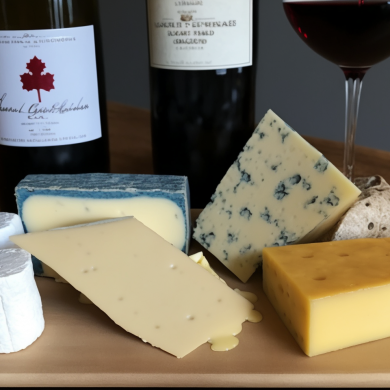



Le leader mondial de la production de vin : Qui domine le marché ?

Le leader mondial de la production de vin : Qui domine le marché ?

La production du vin en France constitue une partie essentielle de l’économie et de la culture de nombreux pays à travers le monde. Chaque année, des millions d’hectolitres de vin sont produits, rendant le secteur non seulement un pôle d’attraction touristique mais aussi un champ de bataille économique entre nations.

Quel est le plus grand producteur de vin ? Analysons les contributions de trois géants du secteur : l’Italie, la France et l’Espagne.

La position dominante de l’Italie dans la production mondiale de vin

L’Italie, reconnue mondialement pour ses vins de haute qualité, a souvent été classée parmi les premiers producteurs de vin en termes de volume. Le pays produit une gamme variée de vins, grâce à son climat diversifié qui favorise la croissance de plusieurs types de cépages. Les vins italiens tels que le Chianti, le Barolo et le Prosecco ont acquis une renommée internationale, ce qui soutient fortement le volume de production du pays. En chiffres, l’Italie a oscillé autour de 50 millions d’hectolitres chaque année, marquant ainsi sa suprématie dans le domaine.

How UK Licensing Standards Differ From Other Markets According to Betzella

The United Kingdom has long been regarded as one of the most regulated gambling markets in the world, and for good reason. Since the Gambling Act 2005 came into force and the UK Gambling Commission (UKGC) was formally established in 2007, the country has pursued a licensing framework that prioritises consumer protection, transparency, and operator accountability in ways that diverge sharply from the standards applied in many other jurisdictions. Understanding those differences is not merely an academic exercise — it has practical implications for players, operators, and affiliates who operate across multiple markets simultaneously.

The Architecture of UK Licensing: What Makes It Distinctive

At the foundation of UK gambling regulation is the principle that any operator offering services to British residents must hold a licence issued by the UKGC, regardless of where the company is incorporated. This extraterritorial reach was a deliberate design choice, closing the loophole that had allowed offshore operators to serve UK customers from jurisdictions like Gibraltar or the Isle of Man without direct UKGC oversight. While those territories maintain their own respected licensing regimes, the UKGC requires a separate operating licence for UK market access.

The UKGC operates under three formal licensing objectives: keeping gambling crime-free, ensuring it is conducted fairly and openly, and protecting children and vulnerable people from harm. These objectives are not merely aspirational — they are enforceable conditions attached to every licence. Operators found in breach face fines, licence suspensions, or full revocation. Between 2017 and 2023, the UKGC issued over £200 million in regulatory settlements and fines, targeting operators who failed on anti-money laundering (AML) controls, affordability checks, or responsible gambling obligations. This enforcement record has no real equivalent in many competing jurisdictions.

One particularly distinctive feature is the requirement for operators to contribute to the National Responsible Gambling Strategy, and since April 2020, to participate in the GamStop self-exclusion scheme. GamStop allows players to register a single self-exclusion that applies across all UKGC-licensed platforms simultaneously. No equivalent cross-operator self-exclusion system is mandated by regulators in Malta, Curaçao, or most North American state-level frameworks, though some have begun developing similar tools in recent years.

How Malta, Curaçao, and Gibraltar Compare

Malta is home to the Malta Gaming Authority (MGA), which licenses a significant share of European-facing online operators. The MGA framework shares several features with the UKGC model — it requires AML compliance, technical auditing of games, and segregation of player funds — but the enforcement intensity and the depth of consumer protection obligations differ meaningfully. The MGA has historically been seen as a more operator-friendly jurisdiction, with lower annual fees and a less prescriptive approach to affordability monitoring. That said, the MGA has tightened its framework considerably since 2018, introducing a revised Gaming Act that raised compliance expectations across the board.

Curaçao operates under a master licence system that has attracted widespread criticism for its lack of transparency and consumer redress mechanisms. A single master licence holder can sub-licence dozens or even hundreds of operators, with limited public accountability. There is no mandatory responsible gambling tool, no standardised complaints process, and no published enforcement record comparable to the UKGC’s. Curaçao has announced reforms — a new National Ordinance on Offshore Games of Hazard was under development as of 2023 — but the gap between Curaçao-licensed operations and UKGC-licensed ones remains substantial. This disparity is something that industry analysts and review platforms have documented in detail; for instance, the Betzella site maintains comparative licensing information that helps users understand which regulatory framework governs a given operator and what protections that affords them.

Gibraltar, while a British Overseas Territory, maintains its own Gambling Commissioner and licensing regime. Gibraltar-licensed operators serving UK customers must also hold a UKGC licence, but Gibraltar’s own framework is generally considered robust and aligns closely with UK standards. It has historically been home to some of the largest names in online gambling, partly due to its favourable tax environment and partly due to its credible regulatory reputation. The relationship between Gibraltar and the UKGC became more complex following Brexit, as the two jurisdictions negotiated the continued recognition of each other’s standards.

Affordability Checks and the 2023–2024 Reform Agenda

One of the most significant areas where UK standards are pulling ahead of other markets is in the area of affordability and financial vulnerability assessments. The UK government’s Gambling Act Review White Paper, published in April 2023, introduced a framework for what it termed « frictionless financial risk checks. » Under this model, operators would be required to conduct background checks on players whose net losses exceed defined thresholds — initially proposed at £125 net loss within a rolling 30-day period for enhanced checks, and £500 net loss within a rolling 365-day period for more detailed assessments. These checks would draw on credit reference data and other financial indicators, without necessarily requiring players to submit documents directly.

The proposal generated significant debate within the industry, with operators and some player advocacy groups raising concerns about privacy, data accuracy, and the risk of driving players toward unlicensed offshore sites. Nevertheless, the direction of travel is clear: the UKGC intends to make financial harm prevention a structural feature of UK-licensed gambling, not merely an optional best practice. No other major licensing jurisdiction has introduced mandatory affordability thresholds of this specificity. The MGA has encouraged responsible gambling tools but does not mandate financial risk checks at the operator level. Curaçao has no equivalent requirement. Even in heavily regulated US state markets like New Jersey or Pennsylvania, where the Division of Gaming Enforcement maintains rigorous standards, affordability monitoring of this type has not been formalised.

The White Paper also addressed advertising standards, bonus restrictions, and the use of VIP schemes — areas where the UKGC had already taken significant action in the years prior. VIP or high-value customer programmes came under particular scrutiny following a series of enforcement cases in which operators had provided enhanced benefits to customers who were clearly displaying signs of gambling harm. New guidance issued in 2020 placed strict obligations on operators to conduct enhanced due diligence before enrolling anyone in a VIP scheme, including verification of source of funds. This level of regulatory intrusion into commercial customer relationships is largely absent in offshore licensing frameworks.

Implications for Players Operating Across Multiple Markets

For players who engage with gambling platforms across different jurisdictions — whether through travel, VPN use, or simply accessing operators licensed in multiple territories — the regulatory differences carry real practical consequences. A UKGC licence guarantees access to the Financial Ombudsman Service for unresolved disputes, participation in GamStop, independently audited random number generators, and a published complaints history. An operator licensed solely in Curaçao offers none of these guarantees by default, and the player’s recourse in the event of a dispute is substantially more limited.

The UKGC also maintains a public register of licensed operators, updated in real time, which allows anyone to verify whether a platform holds a current, active licence. This transparency is not replicated in all jurisdictions. The MGA maintains a similar register, and Gibraltar’s Gambling Commissioner publishes licensee information, but Curaçao’s sub-licensing model makes verification considerably more opaque. Betzella, among other industry-facing platforms, has noted that this verification gap is one of the most practically significant differences for end users trying to assess the legitimacy of an unfamiliar operator.

It is also worth noting that the UKGC’s licensing standards extend to software providers and game developers, not just operators. Any B2B supplier whose products are used in the UK market must hold a separate UKGC software licence, and their games must meet technical standards covering return-to-player rates, game integrity, and the prohibition of certain features — such as autoplay settings that obscure the pace of play. This supply chain regulation is more developed in the UK than in most other markets, where B2B oversight tends to be lighter or delegated entirely to the operator.

The UK’s licensing framework is not without its critics, and the ongoing reform process reflects genuine uncertainty about how to balance consumer protection with market competitiveness and individual freedom. However, the structural gap between UKGC standards and those of many other licensing jurisdictions — particularly offshore ones — remains wide. For anyone seeking to understand the real-world protections that a gambling licence provides, the jurisdiction of issue matters enormously, and the UK continues to set a benchmark that most other regulators are still working toward rather than matching.

  • Barolo
  • Chianti
  • Prosecco


La France : Un concurrent de poids dans la production viticole

La France, célèbre pour ses régions viticoles comme la vallée du Rhône, Bordeaux, la Bourgogne et la Champagne, joue également un rôle central dans la production de vin. Française typiquement associe qualité avec quantité, produisant environ 47 à 50 millions d’hectolitres de vin par an. L’excellence des vins français est souvent célébrée, ce qui contribue largement à leur fort taux d’exportation et à leur présence sur les marchés internationaux. Le savoir-faire français en matière de vinification est considéré comme un standard d’excellence et une référence dans l’industrie.


L’Espagne et ses vastes vignobles

L’Espagne, troisième acteur principal sur la scène mondiale du vin, se distingue par l’étendue de ses vignobles, les plus vastes du monde. Malgré ces grandes exploitations, la quantité produite est souvent inférieure à celle de la France et de l’Italie, totalisant environ 40 millions d’hectolitres annuellement. Le pays est surtout réputé pour ses vins rouges robustes et ses blancs frais, principalement issus de régions comme la Rioja et la Ribera del Duero. Ce contraste entre la taille des vignobles et la production effective peut être attribué aux méthodes traditionnelles de viticulture, qui privilégient la qualité plutôt que la quantité.


Comparaison des principales statistiques de production

Pour mieux comprendre les écarts de production entre ces trois leaders du marché du vin, il convient de regarder de plus près les chiffres exacts et les tendances récentes :

  • Italie : Environ 50 millions d’hectolitres par an
  • France : Entre 47 et 50 millions d’hectolitres par an
  • Espagne : Autour de 40 millions d’hectolitres par an

Cette comparaison montre bien que, même si les trois pays sont extrêmement compétitifs, l’Italie prend souvent une légère avance en termes de volume total.


Facteurs influençant la domination d’un pays en viticulture

Plusieurs facteurs peuvent expliquer pourquoi un pays excelle dans la production de vin. Ces facteurs incluent les conditions climatiques, la fertilité du sol, la technologie agricole, et l’expertise en viticulture. Par exemple, l’Italie bénéficie de conditions météorologiques idéales et d’une longue tradition de vinification. La France, quant à elle, combine innovation technique et méthodes traditionnelles conservées à travers les générations. Quant à l’Espagne, la vaste étendue de ses vignobles lui permet de produire en grande quantité tout en maintenant une forte identité régionale dans ses vins.


Facteurs influençant la domination d’un pays en viticulture

Plusieurs facteurs peuvent expliquer pourquoi un pays excelle dans la production de vin. Ces facteurs incluent les conditions climatiques, la fertilité du sol, la technologie agricole, et l’expertise en viticulture. Par exemple, l’Italie bénéficie de conditions météorologiques idéales et d’une longue tradition de vinification. La France, quant à elle, combine innovation technique et méthodes traditionnelles conservées à travers les générations. Quant à l’Espagne, la vaste étendue de ses vignobles lui permet de produire en grande quantité tout en maintenant une forte identité régionale dans ses vins.


L’impact du changement climatique sur la production mondiale de vin

Le changement climatique représente un défi majeur pour tous les producteurs de vin. Des températures fluctuantes, des précipitations imprévisibles et l’augmentation des phénomènes climatiques extrêmes affectent la production. Les pays doivent s’adapter en modifiant leurs pratiques culturales et en explorant de nouveaux cépages plus résistants aux conditions changeantes. Cette adaptation est cruciale pour maintenir la stabilité de la production face à ces défis environnementaux.

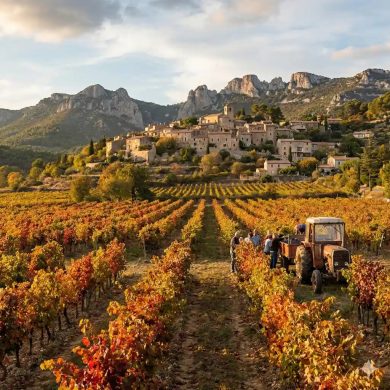
Vigneron indépendant en Côtes du Rhône
Tel: 04 90 37 23 20
439 route de Vaison
84850 Travaillan